Once you get past the idea that hooping is just something that spins around your waist, a whole world opens up. Modern hooping splits into several genuinely different styles, and most hoopers end up moving between more than one. Here’s what’s actually out there, and where to start with each.
There are so many different styles of hooping, why not try them all?
On body hooping
This is where a lot of people begin, it is the iconic hula hoop around the waist and so much more. It’s exactly what it sounds like: the hoop rotates against your body rather than being thrown or manipulated in the air. Waist hooping is the classic starting point, but on body hooping extends way beyond the waist once you build confidence.
Waist hooping — the foundation. Start here if you’re brand new.
Leg hooping — taking the hoop from waist down to knees, ankles, and back up again. Unlock Leg Hooping walks through this specifically.
Shoulder and chest hooping — moving the hoop up your body instead of down, a genuinely different coordination challenge. The 21 Day Shoulder Hooping Challenge is built around exactly this.
Body rocking — moving the hoop fluidly between waist, chest, shoulders, and legs in one continuous sequence, rather than treating each as a separate isolated skill.
Off body hooping and manipulation
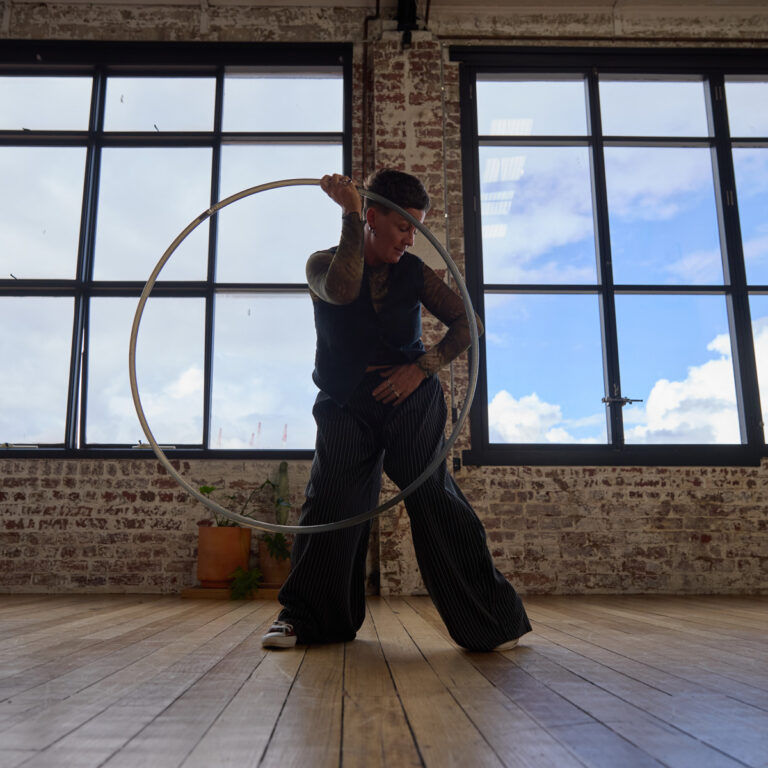
Once the hoop leaves your body, you’re in a different discipline entirely. Off body hooping treats the hoop more like a manipulation prop, closer to what you’d see in circus or flow arts, with tosses, spins, isolations, and weaves done with your hands and arms rather than your torso.
This is where tricks like isolations (making the hoop appear to float, seemingly defying its own momentum), spirals, and hand weaves live. It takes real precision, and it’s genuinely its own subculture within the wider hooping world, often practiced with lighter polypro hoops built specifically for this kind of quick, responsive movement.
And then there are transitions which help us to move from on body to off body and back on again in a continuous flow.
Hoop flow
This is where hooping stops being a series of discrete tricks and becomes a continuous flowing dance. Hoop flow blends on body and off body technique with genuine choreography and self expression, often set to music, often deeply personal in style.
Some hoopers lean technical, chasing precision and difficulty. Others lean fully into flow, prioritising how a sequence feels and looks over how hard it was to learn. Most hoopers land somewhere between the two, and that balance shifts over time, also based on music choice, energy and emotion.
30 Days in Flow is built specifically for developing this side of your practice, one new flow sequence a day for 30 days and it is free.
Weighted and fitness hooping
A separate branch focused specifically on exercise rather than performance or artistry. Weighted fitness hoops are heavier and denser than dance hoops, built to raise your heart rate and work your core harder, closer to a workout tool than a performance prop. This is also the style behind most of the clinical research on hooping’s fitness benefits, since a heavier hoop creates more consistent resistance to measure.
Worth knowing if your goal is primarily fitness rather than performance: you don’t need a weighted hoop to get real benefit, a well-suited-to-your-size standard hoop still works your core and raises your heart rate, but a weighted hoop is a legitimate, well studied option if that’s specifically what you’re after.
Multiples Twins Doubles
Hooping with two, three, or more hoops simultaneously, either spun on the same body part or split across different parts of your body at once. This is a more advanced practice that builds directly on solid single hoop technique, both on body and off body. It is wildly fun and incredible for building strength and coordination.
Try this twin hoop conditioning session if you want to build strength and stamina for twin hooping. You might also love the 21 Day Twin Flow Challenge
LED and fire hooping
The performance end of the spectrum, and also a lot of fun. LED hoops are embedded with programmable lights that create trailing patterns as they spin, popular for night performances and events. Fire hooping goes further, using wicks that are lit and spun, requiring serious technical skill and safety training before ever attempting it. Both are performance disciplines built on top of strong on body and off body fundamentals, but absolutely accessible if you have some hoop friends or hoop makers who can show you the ropes.
Where to actually start
If you’re reading this and feel a little overwhelmed by how many directions this can go, that’s normal, and you don’t need to pick a lane yet. Start with what feels most exciting for you.
Oh and here are 4 moves you are really going to NEED…because no matter how long you have been hooping you will absolutely need these 4 tricks